Mon–Sat: 9:00 AM – 6:00 PM Support
Digital Signature Certificate
Digital Signature Certificate Registration
Fast Processing

Digital Signature Certificate

Overview

What is a Digital Signature Certificate?

A Digital Signature Certificate (DSC) is the electronic equivalent of a physical signature, issued by a licensed Certifying Authority (CA) under the Information Technology Act, 2000. It uses public key cryptography to bind an individual's or organisation's verified identity to a unique digital key, allowing that person to sign electronic documents in a way that is tamper-evident, legally recognised, and admissible before Indian courts and government authorities.
A Note on Digital Signature Certificate (DSC)

Salient Features, Usages, Documents Required, Registration Process and Frequently Asked Questions

1. Introduction

A Digital Signature Certificate (DSC) is the electronic equivalent of a physical signature, issued by a licensed Certifying Authority (CA) under the Information Technology Act, 2000. It uses public key cryptography to bind an individual's or organisation's verified identity to a unique digital key, allowing that person to sign electronic documents in a way that is tamper-evident, legally recognised, and admissible before Indian courts and government authorities.
In India, the Controller of Certifying Authorities (CCA), functioning under the Ministry of Electronics and Information Technology, licenses and regulates the CAs authorised to issue DSCs — among them eMudhra, Capricorn, Sify, and others.

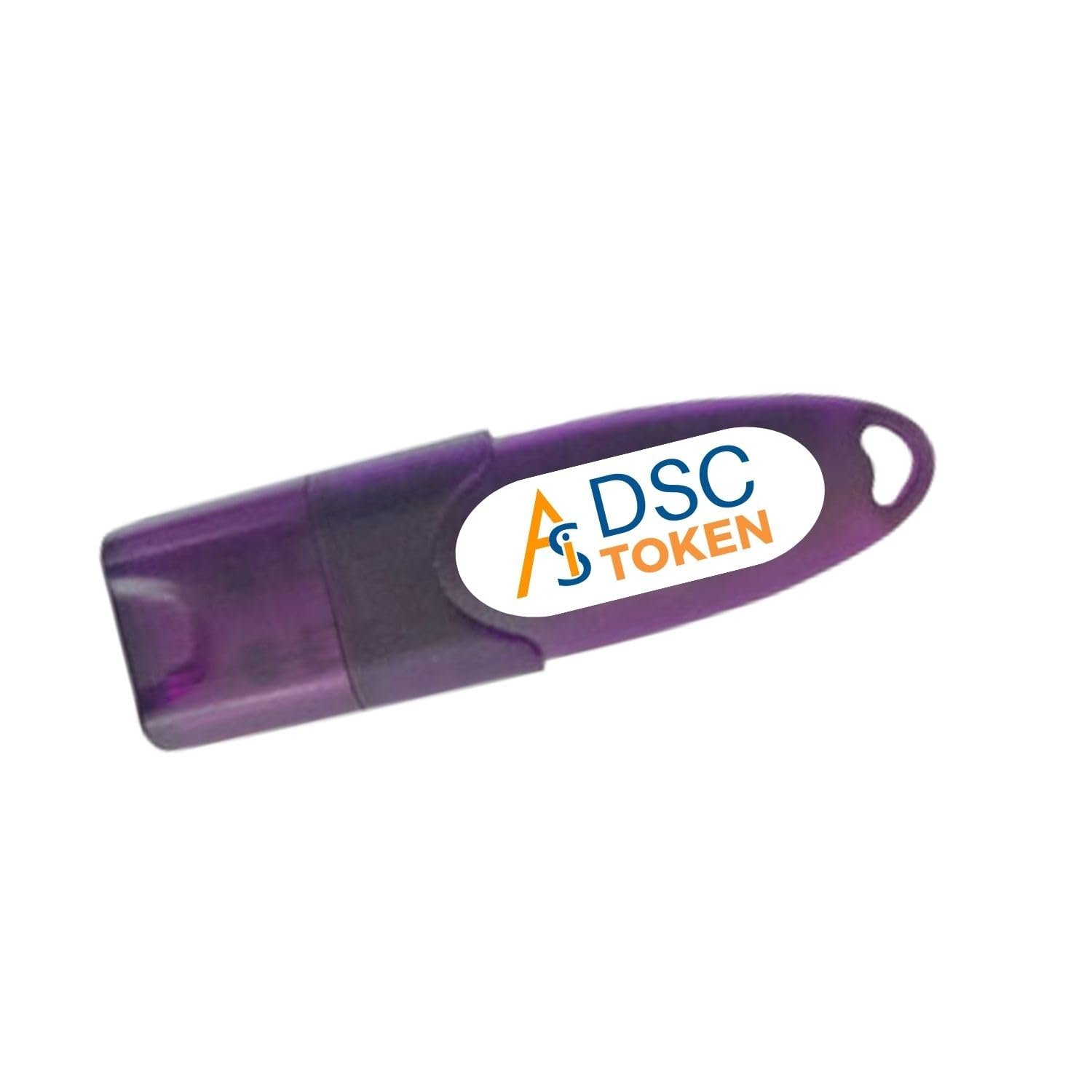
A DSC is issued in the form of a USB cryptographic token (or, increasingly, as a cloud-based signing credential) and is mandatory for a wide range of statutory filings, including company incorporation, income tax and GST returns, customs and foreign trade filings, and participation in government e-tenders.

2. Salient Features

Legal Validity Under the Information Technology Act, 2000, a document digitally signed with a valid DSC carries the same legal standing as a document signed by hand, and is accepted as such by Indian courts and government authorities.
Class 3 is Now the Sole Standard The Controller of Certifying Authorities merged the earlier Class 2 category into Class 3 in 2021, and Class 1 certificates (used only for basic email validation) are no longer issued. As of 2026, Class 3 DSC is the only class issued and is used for all government and business filings.
Highest Level of Identity Assurance Class 3 DSC issuance involves strict verification of the applicant's identity, historically through in-person verification and now predominantly through video-based KYC, making it suitable for high-value and sensitive transactions.
Two Broad Certificate Types A Signing Certificate is used to digitally sign documents, PDFs, and online forms, assuring the receiver that the content is authentic and unaltered. An Encryption Certificate is used to encrypt sensitive files and data before transmission or upload.
Issued to Individuals and Organisations DSCs are available as Individual (personal) certificates, Organisation certificates (issued in the name of a company or entity along with an authorised signatory), and DGFT-specific certificates for foreign trade transactions.
Data Integrity, Portability & Governance A digitally signed document cannot be altered after signing without invalidating the signature. Furthermore, a single DSC token is highly portable across portals and can generally be used to sign filings across multiple government portals — including the MCA21 portal, the GST portal, the Income Tax e-filing portal, DGFT, and ICEGATE.

Operational Mechanics & Management

  • Time and cost efficiency: Eliminates the need to print, physically sign, scan, and courier documents, allowing transactions to be completed securely and remotely.
  • Defined validity period: Issued for a fixed term, typically one, two, or three years chosen at application. Once the validity period lapses, the certificate can no longer be used and must be renewed.
  • Remote, paperless issuance: Most Certifying Authorities now issue DSCs through an online, paperless application process with video-based identity verification, delivering tokens within 1-2 business days for Indian applicants.
  • Revocable and replaceable: If a DSC token is lost, stolen, or compromised, the holder can report it to the issuing CA, which revokes the certificate and issues a fresh token to prevent misuse.

3. Usages of Digital Signature Certificate

Company & LLP Compliance

Mandatory for proposed directors before incorporation (SPICe+, FiLLiP forms) and required for signing annual returns and financial statements on the MCA21 portal.

Taxation (Income Tax & GST)

Corporate entities and entities subject to statutory tax audits must execute ITR filings with a DSC. It is also required for GST registrations, periodic returns, and appeals.

Foreign Trade & Customs

Required for Import Export Code (IEC) registration on the DGFT portal and mandatory for signing shipping bills or bills of entry on the ICEGATE portal.

E-Tendering & Procurement

Bidders must hold a valid Class 3 DSC to participate in public sector tenders, upload documents, and submit secure bids on GeM or the Central Public Procurement Portal.

Additional Applications: A DSC is also required for digital filing of trademark, patent, and intellectual property applications with the Controller General. It secure-authenticates specialized banking, insurance transactions, and signs daily corporate PDFs or enterprise contracts to assure tamper-evident delivery.

4. Documents Required

Documentary mandates remain broadly uniform across certified providers. However, corporate organizational issuances dictate expanded corporate-level verifications.

Applicant Category Key Documents & Information Required
4.1 Individual DSC • PAN Card of the applicant (primary identity proof for Indian residents).
• Aadhaar Card (generally required for Aadhaar-based e-KYC and video verification).
• Recent passport-size photograph.
• Valid mobile number and active email ID (for OTP verification and status track).
• Address proof (Utility bill, bank statement, or Aadhaar itself if requested).
4.2 Organisation DSC • PAN Card of the organisation (Company, LLP, Partnership, etc.).
• Certificate of Incorporation, Partnership Deed, or equivalent registration document.
• PAN and Aadhaar of the specific authorised signatory.
• Board Resolution or formal Authorisation Letter empowering the applicant individual.
• GST Registration Certificate, where applicable, to validate operational address details.
4.3 Foreign Nationals • Valid Passport serving as primary identity proof.
• Visa or active residence permit where applicable.
• Address proof valid in the country of residence (attested as required by the CA).
*Note: Additional notarised or apostilled records apply, and verification timelines range between 3 to 7 business days.

All supporting files are uploaded electronically and verified via a secure video-based KYC workflow call; physical walk-ins at local office branches remain active optional exceptions.

5. Registration & Renewal Process

Step 1: Choose CA & Complete Application

Select a CCA-licensed Certifying Authority (or partner). Fill out details matching your PAN record, select certificate type (Individual/Organisation), context usage (Signing/Encryption), and choose the desired 1, 2, or 3-year validity window.

Step 2: Upload Files & Complete Video KYC

Provide scanned identity/address documentation. Complete the online verification via Aadhaar e-KYC or via the portal's integrated camera video-call confirming original records on camera.

Step 3: Settlement, Issuance & Downloading

Process payments online. Following CA document approval, use the provider's secure token utility software tool to configure and download the certificate down into a portable physical USB cryptographic token, establishing a secure password access PIN.

Step 4: Platform Registration

Map and map-register the newly configured token on destination endpoints (MCA21, GST Common Portal, Income Tax e-filing platform, or ICEGATE) to authorize subsequent system uploads.

5.1 Renewal Guidelines • Renew your token at least 30 days before its active expiry date to guarantee continuity, since expired profiles attract automatic platform-wide ingestion rejections.
• Missing the exact expiry date requires creating a fresh application entirely, complete with identity re-verification and baseline document submissions.

6. Frequently Asked Questions (FAQs)

Collapsible FAQs (or accordions) let visitors browse questions and click to expand answers, keeping pages uncluttered

What is the difference between a digital signature and an electronic signature? +
An electronic signature is generic, referring to any digital format indicating assent (e.g., typed names or scanned signature images), lacking stringent protective security layers. A Digital Signature Certificate relies on robust public key cryptographic technology and is issued explicitly by a licensed Certifying Authority following structured identity checks, yielding top-tier legal validity and anti-tamper security assurances.
Which class of DSC should I apply for? +
As of 2026, Class 3 is the only certificate class actively issued in India; former Class 1 and Class 2 frameworks have been completely phased out and unified into Class 3. You should choose a Class 3 DSC regardless of filing intent, while confirming with your target portal whether a Signing, Encryption, or unified dual-combo certificate structure is necessary.
How long is a DSC valid, and can it be renewed? +
A DSC is standardly provisioned for one, two, or three years during point-of-sale selection. It must be renewed prior to its structural expiration date. The renewal flow mirrors a base application, mandating standard verification workflows and context fee parameters.
Can one DSC be used across multiple government portals? +
Yes. A single physical Class 3 DSC token can simultaneously drive file authentications across MCA21, GST portals, the Income Tax interface, DGFT, and ICEGATE clearing setups, provided you map-register the token on each platform individually before initiation.
Is a DSC mandatory for filing income tax returns? +
A DSC is strictly mandatory for companies, LLPs, and partnership businesses whose accounts are legally required to undergo statutory audits. Individual filers can settle returns using alternative Aadhaar OTP codes, but corporate entities and their designated authorized signatories must sign using a valid DSC token.
How long does it take to get a DSC issued? +
For Indian domestic applicants holding clear PAN and Aadhaar items, issuance wraps up seamlessly inside 1 to 2 business days following successful online video KYC verification and fee settlement. Foreign applicant pipelines experience longer evaluation parameters, requiring 3 to 7 business days.
What happens if my DSC token is lost or the certificate is compromised? +
The device owner should instantly signal the incident to their originating Certifying Authority. The CA terminates/revokes the active profile records to prevent external system exploitation and setups up a replacement process to issue a fresh certificate on a new token following mandatory identity validation.
Do all directors of a company need a separate DSC? +
Yes. Every director tasked with approving statutory documents or signing returns on the MCA21 governance channel for initial incorporation, annual compliance adjustments, or corporate balance sheets must individually secure an authentic Class 3 DSC registered under their proper name.
Can a DSC be used on any computer, or only the one it was issued on? +
Because digital certificates reside directly within a standard physical USB hardware cryptographic token (or cloud-managed credential services), they transition cleanly across computer stations. You only need to verify that local token driver elements or relevant signature execution tools are initialized on the target device.
Is physical, in-person verification still required to get a DSC? +
No, most licensed authorities handle identity verifications through paperless, remote, video-based KYC loops, removing requirements to travel to physical office setups. Walk-in verifications on CA physical premises remain available purely as a fallback optional path.


Start Your Digital Signature Certificate

Complete registration with expert CA support

By submitting you agree to our Terms of Service
Related Services

Also popular with new entrepreneurs